
Vanity Fair "Conversation Pieces"

Shot by Courtney Reader at Gigi's House of Frills. Hair by Sam's Hair Band, makeup by Erin Wheatley
As I mentioned in my previous post about Fifi Chachnil, I have a tendency to get obsessive over things I like. I first saw this incredible peignoir set on Cult of Chiffon's instagram last July and I lost my mind. I immediately messaged her on Etsy asking if I could do layaway on the set because I absolutely had to have it. It's just so ridiculous with all those ruffles, the bows on the sleeves and the collar, and the crystal button that does it up.
The listing said it was a 50s Vanity Fair set and I had grown to love Vanity Fair after having purchased their vintage loungewear and having done research on them. But this set was totally different and it wasn't like anything I'd seen before by the company, or any vintage loungewear brand at the time.

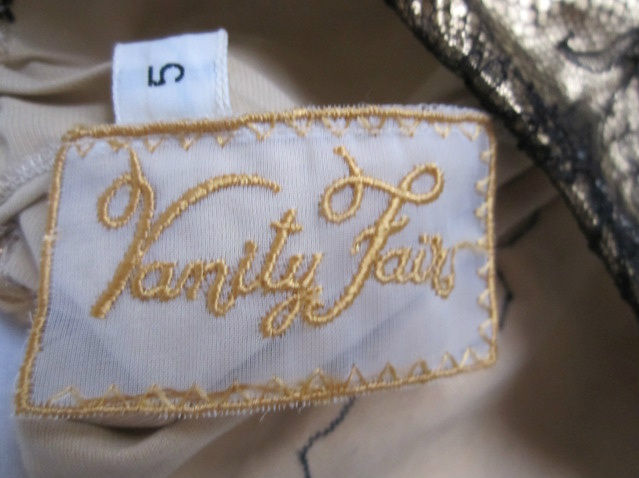
I got the set in the mail a little while later and firstly was astounded at the construction of the garments, how high quality they were, how light and soft the chiffon was, and just how magnificent the set was! I put it on and pranced around and it was so fluffy that it scared my cat! I took it off and noticed the label was quite different from most Vanity Fair labels at the time. The peignoir has a big fabric label that says "Vanity Fair" in gold letters. This caught my attention because I hadn't seen a Vanity Fair label like it before on a piece from the midcentury. Vanity Fair labels on 50s/60s pieces usually look like the one below:

The usual VF label is somewhere on the seam and is fairly small. The label on my garments was large and on the neckline and looked like this:
I pulled this shot from here because it's too much work to get the peignoir set off the mannequin I keep her on!
I did some digging into what the fabric label with gold lettering could mean. As it turns out, this peignoir set is part of a small run of a high-end collection Vanity Fair did in the 1950s-60s called "Conversation Pieces". Pieces from this collection are so extravagant and over-the-top that lingerie and slips from this collection often had 24k gold in them, crystals on them, hand beading, and other crazy details. Some examples from the collection are below:


The collection was launched in 1955 and an ad placed in The Sunday Herald titled: Lingerie Glitters in Gold, in December 1955 claims:
For the girl who dreams of gold for Christmas there is nylon lingerie lavished with gleaming 'cloth of gold' accents offered by Vanity Fair. An aura of excitement goes with garments trimmed with this rich tricot impregnated with 24-karat gold. Despite its dazzling luxury, the lingerie has a practical side because it is made with Du Pont nylon. The manufacturer states that the garments can be washed without damaging the gold coating, but advises against dry-cleaning. Despite the layer of precious metal the fabrics remain soft, supple, and drapable. Vanity Fair is using fabrics that have an extravagant, Arabian Nights [oh the 50s, love the fashion, not into the racism and stereotypes] kind of opulence. The plain gold fabric is sometimes appliquéd or overlaid with Chantilly lace, sometimes combined with layers of sheer nylon tricot, in black over black, or white over pink. A theatre slip, two beautifully styled nightgowns, an elegant peignoir, a bra and briefs also take on the 'Midas' look. Available at all stores carrying the Vanity Fair lingerie line, the 'cloth of gold' tricot items come in sizes 32-38 and are priced from $12.95 to $99.95.
This was a very expensive line, today it would range between $118- $900USD and based on what I've read about the development and production of lingerie in the early to mid-century, would have been one of the first mass-produced luxury lingerie lines. It makes sense that it would have happened at this time, the 1950s saw a massive boom in the mass-produced lingerie industry and it went through a sort of renaissance. Lingerie went through massive developments in the 1950s and more colours, styles, and fabrics were being offered to the public for their underpinnings. The 1950s also saw an economic boom in North America and people were more eager to spend their money on luxury goods. I suppose people were so tired of scrimping and saving like they had to in the 30s and 40s that when they finally had some money, they spent it on extravagant non-necessities.

It is very difficult to find any information about the Conversation Pieces line other than the small ad placed in the Sunday Herald and from blog posts here and there about individual pieces from the line, often from the poster's personal collection. I have to assume that the line didn't run very long, maybe only into the early 60s, if that. I have seen quite a few pieces from the line here and there on eBay, Etsy, and other vintage websites but no one seems to know all that much about this collection and how many pieces from it there are.
It took me ages to even find proof online that the peignoir set I bought is from this collection and I scoured the internet high and low trying to find it. I just found the ad above on Pinterest featuring the peignoir set but unfortunately, the post didn't provide me with much information about the ad, where it came from, and about the set itself. However, it did say that the set is from the 60s (which contradicts other posts about it so it's hard to date, it could be late 50s/early 60s) and it gives a price: $100USD. That's about $850UDS today or about $1100 if you're Canadian like me.
If it is from the 60s, it's likely to have been at the tail end of the production of the line and it seems like such an extravagant set that it's likely that not many were made. This would explain it being very hard to find online.

Shot by Jamie T Photography, hair by Sam's Hair Band, makeup by Erin Wheatley
I hope this has been an interesting read and an interesting glimpse into a small part of lingerie history! Let me know if you know anything more about this collection or anywhere I could learn more about it!
Comments